
Pools & Spas

How to Prime Your Pool Pump

Your pool pump is the central piece of equipment that allows the function of your pool filtration system. It keeps the water moving so that dirt and debris can be filtered out and so that your pool chemicals can do their job effectively.

Without a functioning pool pump, your pool water can quickly become stagnant. Keeping your pool pump functioning is essential to maintaining a clean and healthy swimming pool. By extension, knowing how to take care of your pool pump is also crucial so that you can avoid costly repairs and replacements.

We are often asked, “my pump isn’t priming, what do I do?” A pool pump often gets pockets of air trapped inside. Anytime that it is not operating full of water such as when the pool is closed down or re-opened for the season, there is a potential to get air inside the pump. Before you can operate a pool pump that has air in it, you will need to blow out the lines with water to get rid of any air and replace it with water. This process is priming the pump.

It is important that a pool owner should learn to prime their pump as operating a dry pump can lead to possible damage to surrounding fixtures. These devices are only to run when they are full of water.

Steps to Priming Your Pump

A precautionary first step may be to check your water levels, empty out your skimmer basket of debris, backwash (if you have a sand filter) or clean your filters (if cartridge).


1. Turn off the pump. Although your pump is probably already off if you need to prime it, make sure that the power button is truly in the off position or that power has been disconnected to the unit. Anytime that you are working with water and electricity, heed additional safety precautions before beginning your task.

2. Switch to recirculate. The multiport valve on your filter can be set to recirculate (or whirlpool on some filters) the water. This will bring water directly into the pump and then recirculate it back out into the pool. In the recirculate setting, the water bypasses the filter and goes directly into the pump to ensure that there is in fact, water in the pump.

3. Release air. Relieve excess air pressure in the lines by opening up the air relief valve located on top of the filter (if sand filter)

4. Clean out the pump basket. Remove any debris that has collected in the basket and rinse with a hose. Inspect for wear and tear and replace parts like o-rings as needed.

5. Fill the pump basket. Use a garden hose to slowly fill the pump basket and put the lid back in place.

6. Once the pump basket is filled and tightened, make sure the air release valve is open and turn the power to the pump on.

7. Check the water flow to your pump. Water should be consistently flowing within thirty seconds. If you do not have a consistent flow, turn the pump back off and repeat the previous steps. Thoroughly re-check all of your hardware for wear and tear.

Once the water is constantly flowing, close the air pressure release gauge (most commonly found with sand filters- other filter styles generally have a pressure release valve).
Pool Facts!

Ever wonder what the most common pool type is? How about where the largest residential pool is located? Maybe not, but I’ll tell you anyways. Here are some pool-related facts:

  1. The world’s oldest known swimming pool is The Great Bath, located in Mohenjo-Daro, Pakistan. This pool is estimated to date all the way back to the 3rd millennium BC.

  2. It is estimated that there are over 10,500,000 residential swimming pools in the US.

  3. You may have heard that the Buffalo, NY area has the most pools per capita in the US. Unfortunately, this is not true! The city with the most residential swimming pools per capita in the US is Phoenix, AZ (but other cities have also been listed #1).

  4. The most common pool type is vinyl.

  5. The White House has 2 pools; one indoor (built in 1933 for FDR, closed in 1970 by Nixon) and one outdoor built in 1975 for Gerald Ford.

  6. Surprisingly, pool filtration systems have actually been around for over 110 years- invented at Brown University in 1910.

  7. A Olympic-sized swimming pool, which is 50 meters by 25 meters and at least 2 meters deep, has enough water to fill 9,400 bathtubs.

  8. Australia builds more residential swimming pools per capita than any other country in the world.

  9. Approximately only 38% of pools having a diving board.

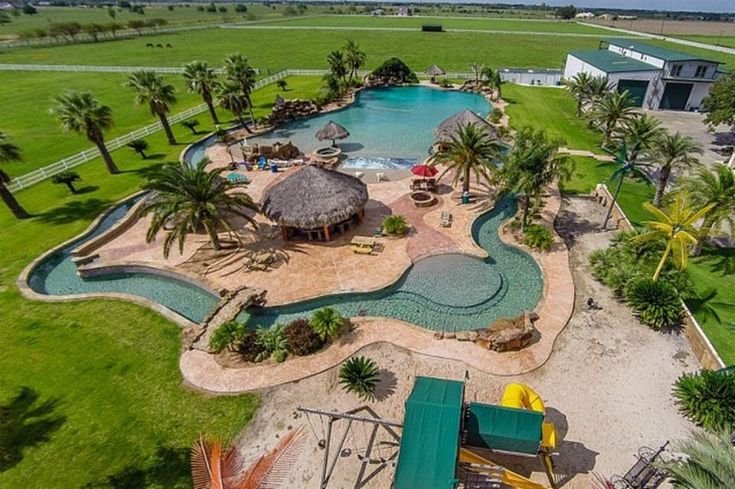
  10. The largest residential pool in the United States is in Texas (I guess everything really IS bigger in Texas). Located in El Campo, Texas, the pool holds 600,000 gallons (for reference, an Olympic-sized swimming pool holds roughly the same amount). There is a rock climbing wall, a playground, a rope swing, a 21 foot-long slide, a swim-up bar a 30-seat spa, genuine Florida palm trees and a 500 foot lazy river…!!

The largest residential swimming pool in the US!

Ways You Can Keep Your Pool Area Safe

Your backyard oasis can be the most used space on your property, and rightfully so! That being said, your pool comes with a unique set of responsibilities. The last thing anyone wants when enjoying their pool is for someone to get hurt. There are laws and regulations to be sure to follow and best practices that will make your swimming experience more enjoyable!

Pool Covers: Covers are a great way to maintain a safe environment, even when the pool is not in use. Covers not only keep children from inadvertently falling into the pool, but also keep unwanted leaves, debris and animals out of the pool. Furthermore, covers help to save energy and conserve water by helping to keep in water, heat and chemicals that could otherwise evaporate into the atmosphere.

Fence or Barrier: A fence gives owners a sense of relief that a child, grandchild, young neighbor or pet are prevented from wandering into the pool. There are plenty of options for fences that meet code requirements without disrupting the aesthetics of your yard. It is always best to consult your local laws to determine if a fence is required and what standards the fence must meet.

Pool Alarm: There are several types of alarms that signal when the pool area is being disturbed, such as when the back door or the gate is opened, or when someone has entered the water. Water alarms are usually able to tell the difference between a larger creature versus a toy or rain, thereby possibly reducing the nuisance of an alarm constantly going off. Test the alarms from time to time to ensure they are in working order.

Lighting: Light all safety areas such as pool steps, entrances and exits.

Other suggestions:

  • Ensure your swimming pool and/or hot tub complies with the Virginia Graeme Baker Pool & Spa Safety Act (VGBA), which requires features to prevent entrapment. Entrapment can occur when a pool/spa suction outlet (drain) creates higher than allowable suction forces and can hold a bather/swimmer down at the suction outlet/drain cover, trapping them below the surface of the water. Make sure that the suction outlet (drain) covers are in good shape, not cracked/broken, and properly secured in place.

  • Keep a float or ring nearby- handy for emergency use.

  • Ensure your ladders and handrails are properly secured.

  • Routinely check over your pool equipment to make sure everything is operable.

  • With children around, designate someone to be in charge of watching and keeping a steady on the children.

  • Maintain proper water chemistry to preserve the condition of your pool and its equipment as well as to avoid irritation of swimmer’s skin and eyes.

  • Make sure all who use the pool can swim and feel comfortable using your pool and practice protocol that would prepare for an accident.

We want you to love your Colley’s Oasis while also maintaining an atmosphere of safety. Luckily, both can be done!

Gunite vs. Vinyl vs. Fiberglass Pools

If you are considering having a new in-ground pool installed by Colley’s it is important to understand the difference between the 3 options; gunite, vinyl and fiberglass.

  1. Gunite

    Using a rebar framework, we spray a concrete, water and sand mixture to create a gunite pool surface. Often times, the terms gunite and concrete can be used interchangeably.

    Gunite pools are extremely customizable- giving the customer the widest range of personalization. In turn, gunite pools are often considered to be the most aesthetically pleasing.

    Additionally, gunite pools are very durable- the structure itself can last for many decades, but it will require resurfacing every 10 years or so. As with every pool, gunite pools require proper maintenance to keep the pool in operable shape.

    Gunite pools are the most expensive of the 3 options, in general. With the customization factor, there are typically many add-ons and features you can add to a gunite pool that you are unable to do on a vinyl or fiberglass pool which can add cost to your project.

    Gunite pools are also the most time-consuming to install and requires a labor-intensive process (possibly more so than vinyl or fiberglass).

    So, if you are looking for a highly customizable, durable option and are aware of the higher cost and longer installation time, a gunite pool may be right for you!

  2. Vinyl

    A vinyl pool is formed with reinforced steel wall panels with a vinyl liner placed over the walls and floor of the pool.

    While a vinyl pool is not as customizable as a gunite pool, there are still a decent range of shape options you can choose from. Additionally, with our line of Craftworks liners you can choose from a wide-variety of patterns to design your pool the way you want!

    Vinyl pools are generally the most cost-effective of the 3 options and the process to install is generally more straightforward.

    On the flip side, vinyl liners do have a lifespan which is generally 10 years give or take. The lifespan of a liner depends on how well you maintain you pool, how often it is used, how much sunlight you get in your yard and various other factors. It is important to maintain upkeep of your vinyl liner to increase its longevity and protect the structure of your pool.

    Vinyl pools are the most common option, generally the most cost-effective and somewhat customizable!

  3. Fiberglass

    A fiberglass pool is pre-molded from fiberglass-reinforced plaster. We install the prefabricated, fiberglass pool into the ground.

    The draw with fiberglass pools is that they are non-porous and generally easier to maintain than a gunite or vinyl pools. Once the pool has been manufactured and has arrived to Colley’s, installation is generally a straightforward process.

    While there are a wide range of shape options, you must remember that a fiberglass pool is prefabricated and thus the possibilities are finite based upon the manufacturer’s options.

    So, fiberglass pools are highly durable, moderately customizable and generally mid-range pricing between gunite and vinyl.

So, as you research the options for your backyard oasis keep in mind that each pool option has unique attributes, varying pricing and differences in the installation process and maintenance of the pool. So, find out what is most important to you in a new pool and consult with one of Colley’s Sales Consultants who can walk you through all there is to know about designing your new backyard oasis!